NFC vs. QR Codes for Voice Recording Jewelry
Compare appearance, convenience, durability, scanning, and the overall experience of the two most common ways to connect personalized jewelry to meaningful audio.
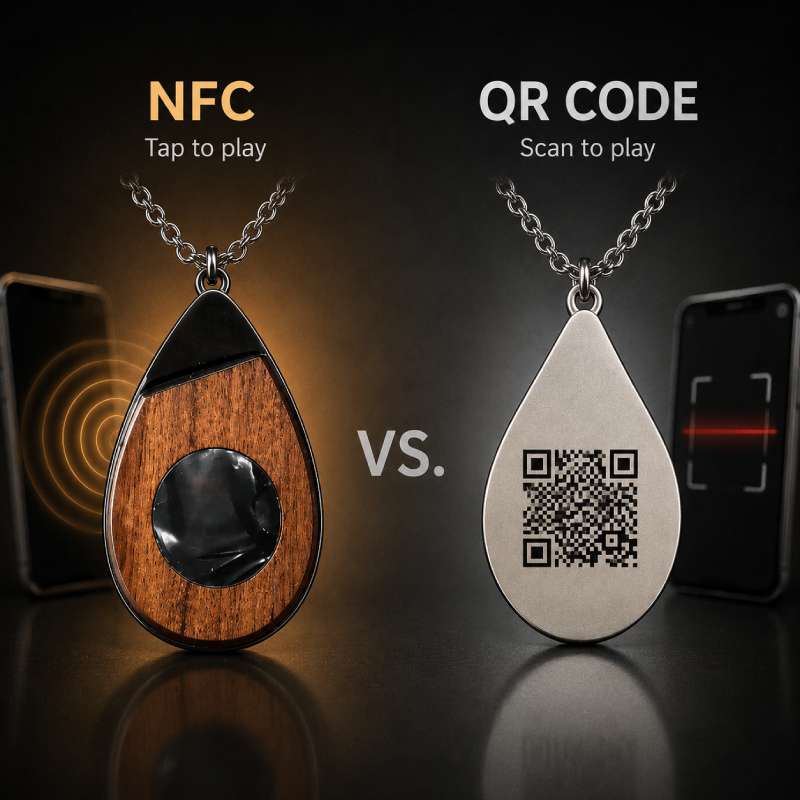
Two different ways to open the same kind of memory
NFC chips and QR codes can both connect a necklace, bracelet, keychain, or other personalized keepsake to an audio recording. In many cases, neither method stores the full recording inside the jewelry. Instead, it provides a way for a phone to open a link to hosted audio.
The difference is in how the phone reads that link and how the technology becomes part of the design.
1. How NFC and QR codes work
NFC playback
NFC stands for near-field communication. A small chip and antenna are placed inside or behind the jewelry. When a compatible phone is held close to the intended tap point, the phone reads the link stored on the chip and displays a notification.
The wearer taps that notification to open the recording. The NFC tag is passive, so it does not need a battery or charging.
QR code playback
A QR code is a visible square pattern that can be printed, engraved, etched, or placed on the jewelry. The wearer opens the phone camera, points it at the code, and taps the link that appears.
The code itself represents the web address used to reach the recording.
Both NFC and QR codes commonly connect the phone to hosted audio through a web link. The jewelry usually acts as the access point rather than storing and playing the complete recording itself.
2. Appearance and design
The biggest visible difference is whether the playback technology needs to remain part of the surface design.
NFC can be concealed
An NFC chip can be hidden within or behind the pendant, allowing the front to focus on the materials, engraving, photo, or personalized design.
QR codes must remain visible
A QR code must be exposed and readable by the camera, so the square pattern becomes part of the jewelry’s appearance.
Design space matters
On a small pendant, a visible QR code may compete with names, dates, photos, or Soundwave engraving for limited space.
A QR code needs enough size, contrast, and clear space to remain scannable. NFC can stay hidden, but its placement and surrounding materials affect how reliably it reads.
3. Convenience and everyday use
Both methods can be simple, but they create different habits for the wearer.
NFC: hold and tap
The wearer brings the phone close to the intended tap point, waits for the notification, and opens it.
QR: open and aim
The wearer opens the camera, positions the code inside the frame, waits for recognition, and opens the link.
Lighting
QR scanning depends on the camera being able to see the code clearly. NFC does not depend on room lighting.
Alignment
NFC requires close alignment between the phone’s reader and the tag. QR requires the entire code to be visible to the camera.
Phone handling
NFC can feel more direct once the tap point is understood. QR scanning may feel more familiar because most people already know how to use a phone camera.
Learning curve
QR codes are visually obvious. Hidden NFC usually benefits from clear instructions showing where to tap.
4. The scanning experience
Neither method is completely automatic. Each requires the phone to recognize the link and the wearer to open it.
NFC scanning
The phone must be unlocked, NFC must be available, and the phone’s reader needs to align closely with the chip.
QR scanning
The camera needs a clear, well-lit view of the full code with enough contrast to recognize the pattern.
Cases and accessories
Thick cases, metal components, magnetic accessories, or attached wallets may interfere with NFC detection.
Surface condition
Scratches, glare, low contrast, dirt, or damage can make a QR code harder to scan.
Distance
NFC is intentionally short range. QR codes can sometimes scan from farther away if the code is large and clear enough.
Repeat use
Once the wearer learns the best phone position, NFC can become very quick. QR remains straightforward when the code stays easy to see.
5. Phone compatibility
QR codes work with phones that have a camera and software capable of recognizing QR links. NFC requires compatible NFC hardware in the phone.
Many modern smartphones support both, but the experience can differ by model, age, settings, and software.
Questions to ask about compatibility
- Does the intended phone support NFC tag reading?
- Does NFC need to be enabled in the phone’s settings?
- Where is the NFC reader located on that phone model?
- Can the phone camera scan standard QR codes without another app?
- Will a case, wallet, or magnetic accessory interfere?
- Does the linked recording open properly in the phone’s browser?
If the recording is hosted online, the phone still needs a working connection when the link opens.
6. Durability and wear
The long-term performance of either method depends on the materials, construction, and how the link is managed.
NFC is protected by placement
A concealed NFC chip can be protected beneath an inlay or inside the jewelry, reducing direct surface exposure.
QR codes depend on visibility
The code must remain exposed, readable, and high contrast. Surface wear can affect scanning if it changes the pattern.
Materials affect both
Metal, thickness, coatings, adhesives, engraving depth, and protective layers can all influence long-term performance.
NFC chip ratings vary
Some commonly used NFC chips are rated for approximately 10 years of data retention under normal conditions.
A QR pattern does not expire by itself
A printed or engraved QR code can remain readable as long as the pattern stays intact and the linked destination continues working.
The link is a separate issue
With both methods, the jewelry may remain physically intact even if the hosted recording or destination URL changes.
7. Visibility and privacy
Neither NFC nor QR should be treated as a security system by itself, but the methods differ in how obvious the playback link is.
NFC can be discreet
A hidden chip does not reveal the playback method visually. Someone must know where to bring a compatible phone close to the pendant.
QR codes invite scanning
A visible QR pattern signals that it can be scanned, and anyone with a camera may be able to open the same destination.
The destination controls access
True privacy depends on how the linked page or recording is protected, not only whether NFC or QR is used.
A concealed NFC chip is less visually obvious, but the link may still be opened by another compatible phone if the tag is scanned.
8. Long-term recording access
For both NFC and QR jewelry, the most important long-term question may be what happens to the linked recording.
A QR code or NFC tag can point directly to a file, a web page, a redirect, or a service controlled by the seller. The setup determines whether the recording can be updated and whether continued access depends on the company maintaining that link.
Questions worth asking before buying
- Where is the recording hosted?
- Does access require an account or subscription?
- Will the link remain available long term?
- Can the recording or destination be updated?
- What happens if the seller changes platforms?
- Is support available if playback stops working?
The jewelry can still scan correctly while the destination no longer works. Long-term hosting and support matter with both methods.
NFC vs. QR code comparison
This table summarizes the typical experience. Individual products may differ depending on their construction and setup.
| Feature | NFC | QR Code |
|---|---|---|
| Appearance | Can be hidden inside or behind the jewelry | Must remain visible and readable |
| How it opens | Hold a compatible phone near the tap point | Open the camera and aim at the code |
| Lighting | Does not depend on visible lighting | Needs enough light and contrast for the camera |
| Distance | Very short range | Can scan from farther away if large and clear |
| Phone requirement | NFC-enabled phone | Camera with QR recognition |
| Surface wear | Chip may remain protected beneath the surface | Damage to the visible pattern may affect scanning |
| Visual privacy | Playback method can remain discreet | Visible code makes scanning purpose obvious |
| Battery required | No | No |
| Dedicated app required | Usually no for a standard web link | Usually no with built-in camera recognition |
| Long-term access | Depends on the linked destination, hosting, and company support | |
9. Which playback method is better?
There is no universal winner. The better method depends on the design, the intended wearer, and which tradeoffs matter most.
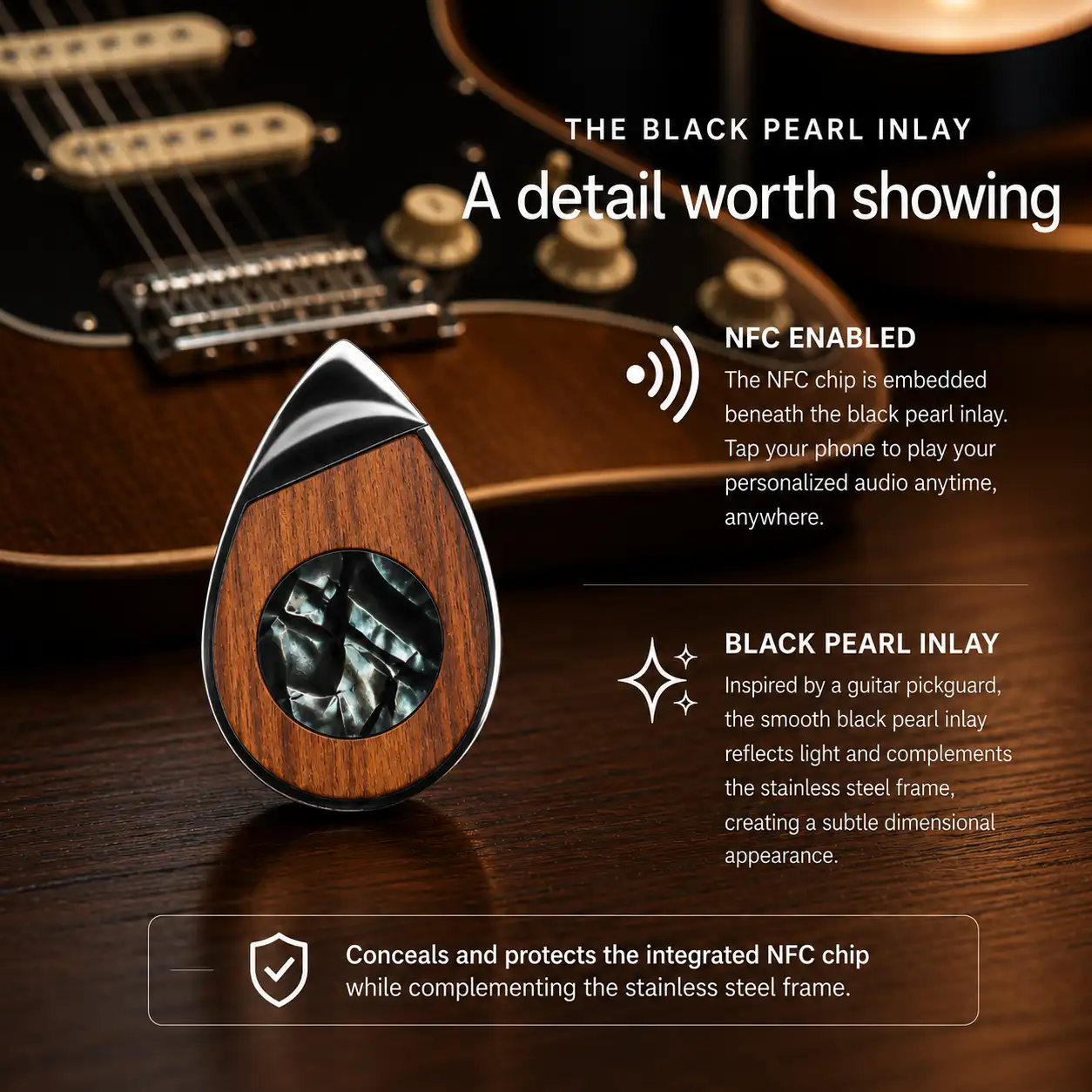
Why we chose concealed NFC
Soundwave Art™ chose NFC because the playback technology could be integrated without placing a visible QR code on the pendant.
The black pearl inlay on the back conceals and protects the NFC chip while serving as the intended tap point. This allows the front to remain focused on the customer’s personalized Soundwave, optional text, natural ironwood, and stainless steel frame.
The result is jewelry that looks personal and finished even when it is not being used for playback. Each necklace is linked to the customer’s recording and tested before shipping.
Explore Playable NecklacesNFC and QR code jewelry questions
These answers cover common questions about scanning, appearance, durability, and long-term access.
Is NFC better than a QR code for jewelry?
NFC is often a strong fit when the technology needs to remain hidden. QR codes may be preferable when visible camera scanning is more familiar or when the code can be made large enough to scan easily.
Do NFC and QR codes store the recording?
Usually not. Both methods commonly store or represent a web link that opens audio hosted elsewhere.
Does NFC require an app?
A standard NFC web link usually does not require a dedicated app on a compatible phone. The phone reads the tag and opens the destination through its normal browser.
Does a QR code require an app?
Many modern phones recognize QR codes through the built-in camera, although the experience can vary by device and settings.
Can an NFC chip or QR code stop working?
Yes. Physical damage, poor integration, surface wear, phone compatibility, or a broken destination link can affect playback. The risks differ between the two methods.
Which method is more private?
Hidden NFC is less visually obvious, but neither method is automatically private. Access depends on how the linked page or recording is protected.
Can the recording be updated later?
That depends on how the seller manages the destination. With either NFC or QR, it may be possible to update the linked audio without replacing the jewelry.
Continue learning
Explore more guides about NFC playback, voice recording necklaces, and personalized jewelry.
Explore necklaces made playable with hidden NFC
Turn a meaningful recording into a handcrafted ironwood necklace engraved with your unique Soundwave and connected to the audio through concealed NFC technology.
Explore Playable Necklaces